Donald Trump pledges to pardon the former Honduran president currently serving a sentence after being convicted in a high-profile drug-trafficking case.
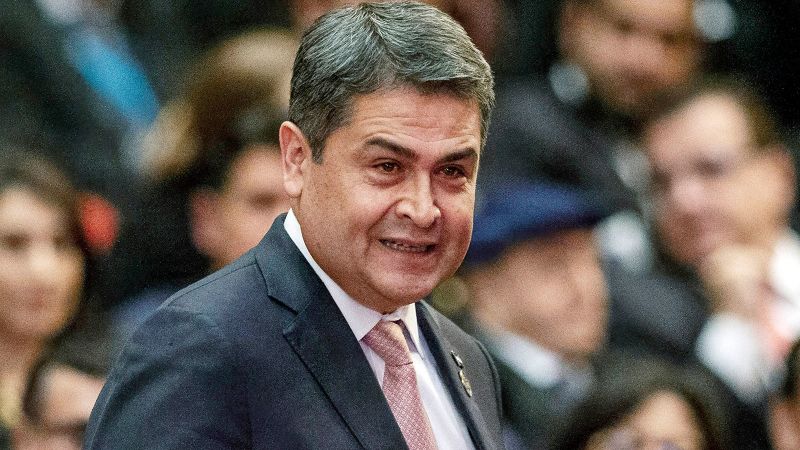
**Trump's Pardon Promise for Honduran Ex-President Ignites Firestorm Over Justice and Geopolitics**
In a declaration that sent shockwaves through the corridors of justice and international relations, former President Donald Trump recently announced his intention to pardon Juan Orlando Hernández (JOH), the former president of Honduras, who was recently convicted in a U.S. federal court on charges of drug trafficking and weapons offenses. This provocative statement, made at a campaign rally, is not merely a piece of political rhetoric; it is a profound signal that, if realized, could fundamentally reshape the U.S. approach to fighting transnational crime, strain diplomatic ties, and deeply challenge the principles of rule of law.
Juan Orlando Hernández, who served as president of Honduras from 2014 to 2022, was once seen as a key U.S. ally in the fight against drug trafficking and illegal migration in Central America. However, his carefully cultivated image crumbled in March 2022 when he was extradited to the United States following an indictment alleging his involvement in a massive drug conspiracy. His subsequent trial in New York revealed a startling web of corruption, with prosecutors presenting compelling evidence and testimony from notorious drug lords who claimed JOH accepted millions of dollars in bribes to facilitate the movement of tons of cocaine through Honduras en route to the United States. He was accused of using his position to protect traffickers, manipulate elections, and even exploit state resources for his criminal enterprise, essentially turning Honduras into a "narco-state." After a two-week trial, a jury found him guilty on all three counts: conspiracy to import cocaine, conspiracy to possess machine guns, and actual possession of machine guns in furtherance of the cocaine importation conspiracy. He now faces a potential life sentence, a stark reminder of the U.S. government's commitment to prosecuting high-level corruption.
Trump's promise to pardon Hernández, therefore, flies directly in the face of years of diligent investigative work by the Drug Enforcement Administration (DEA) and the Department of Justice (DOJ), as well as the significant resources expended on his extradition and prosecution. The former president framed his pledge within his broader narrative of a "weaponized justice system" and a "rigged" government, suggesting that Hernández, like himself, is a victim of politically motivated prosecution. "The former president of Honduras, who's a really a terrific guy, he's being persecuted," Trump reportedly stated, hinting that JOH was unfairly targeted for cooperating with the U.S. on immigration issues. This aligns with Trump's tactic of portraying those targeted by U.S. law enforcement as political prisoners, especially when it involves perceived enemies of his administration or foreign leaders he had dealings with.
The implications of such a pardon are multifaceted and severe. First and foremost, it would profoundly undermine the U.S. justice system. A presidential pardon for a convicted foreign head of state involved in major drug trafficking would send an unequivocal message that high-level officials, even those found guilty by a jury of their peers, can escape accountability through political favor. This would not only demoralize federal prosecutors, agents, and analysts who dedicate their careers to dismantling transnational criminal organizations but also erode public trust in the impartiality and effectiveness of American law enforcement. It would effectively signal that the U.S. is willing to overlook grave crimes if they align with a president's political agenda or personal relationships.
Beyond domestic concerns, the geopolitical ramifications would be immense. For Honduras, where Hernández's conviction was seen by many as a vital step towards accountability and combating deep-seated corruption, a pardon would be a devastating blow. The current Honduran government, led by President Xiomara Castro, who campaigned on an anti-corruption platform and facilitated JOH's extradition, would likely view such a move as a direct affront. It could severely strain U.S.-Honduran relations, potentially undoing years of diplomatic effort aimed at strengthening democratic institutions and the rule of law in a strategically important Central American nation. Moreover, it could embolden corrupt politicians and drug traffickers across the region, suggesting that U.S. prosecution is not an irreversible threat and that a change in U.S. administration could offer a lifeline. The message to other governments collaborating with the U.S. on anti-drug efforts would be confusing and detrimental, potentially leading to a decrease in cooperation.
Historically, presidential pardons, while constitutionally granted, have always been subject to scrutiny. From President Gerald Ford's controversial pardon of Richard Nixon to President Bill Clinton's eleventh-hour pardon of financier Marc Rich, these acts have often sparked intense debate about their propriety and the balance of power. However, pardoning a former head of state convicted of facilitating massive drug trafficking into the U.S. would stand as a virtually unprecedented act in modern U.S. history concerning such serious international crimes. It goes beyond the traditional scope of pardons for political allies or those seen as victims of overzealous prosecution; it involves a clear-cut case of a foreign leader using the power of his office to facilitate criminal enterprises on a grand scale.
Should Trump win the presidency, his promise would face significant domestic and international backlash. While his base might applaud a move seen as challenging the "deep state," moderate voters and international allies would likely view it with alarm, raising serious questions about the U.S.'s commitment to global anti-corruption efforts and its standing as a leader in promoting justice and the rule of law. It would also fuel concerns about transactional foreign policy, where justice becomes a negotiable commodity rather than a steadfast principle.
In essence, Donald Trump's declaration about pardoning Juan Orlando Hernández is far more than just campaign rhetoric. It represents a potential radical departure from established U.S. foreign policy and judicial norms. It signals a willingness to overturn hard-won victories against transnational crime, to risk crucial diplomatic relationships, and to potentially redefine the very meaning of justice in the international arena. The consequences of such a decision, if implemented, would reverberate for years, impacting not only the fight against drug trafficking but also the credibility and moral authority of the United States on the global stage. It forces a critical examination of what principles would truly guide American power should Trump return to office.
Comments
Post a Comment